Who is about to stop coming

A client doesn't send you a letter to say she's not coming back. She comes less often, skips a round, and one day you notice you haven't seen her in months. Six analyses look at this moment from six different angles, and none hands you a list of names to interpret: they tell you who to call today, why, and with what message.

The questions it answers

  • “Who is about to disappear?”
  • “What are the ones I'm losing worth?”
  • “Are my clients coming less often?”
  • “The clients I gained in January, what have they really earned me?”

Lives in Business → Analysis · Smart Recontact

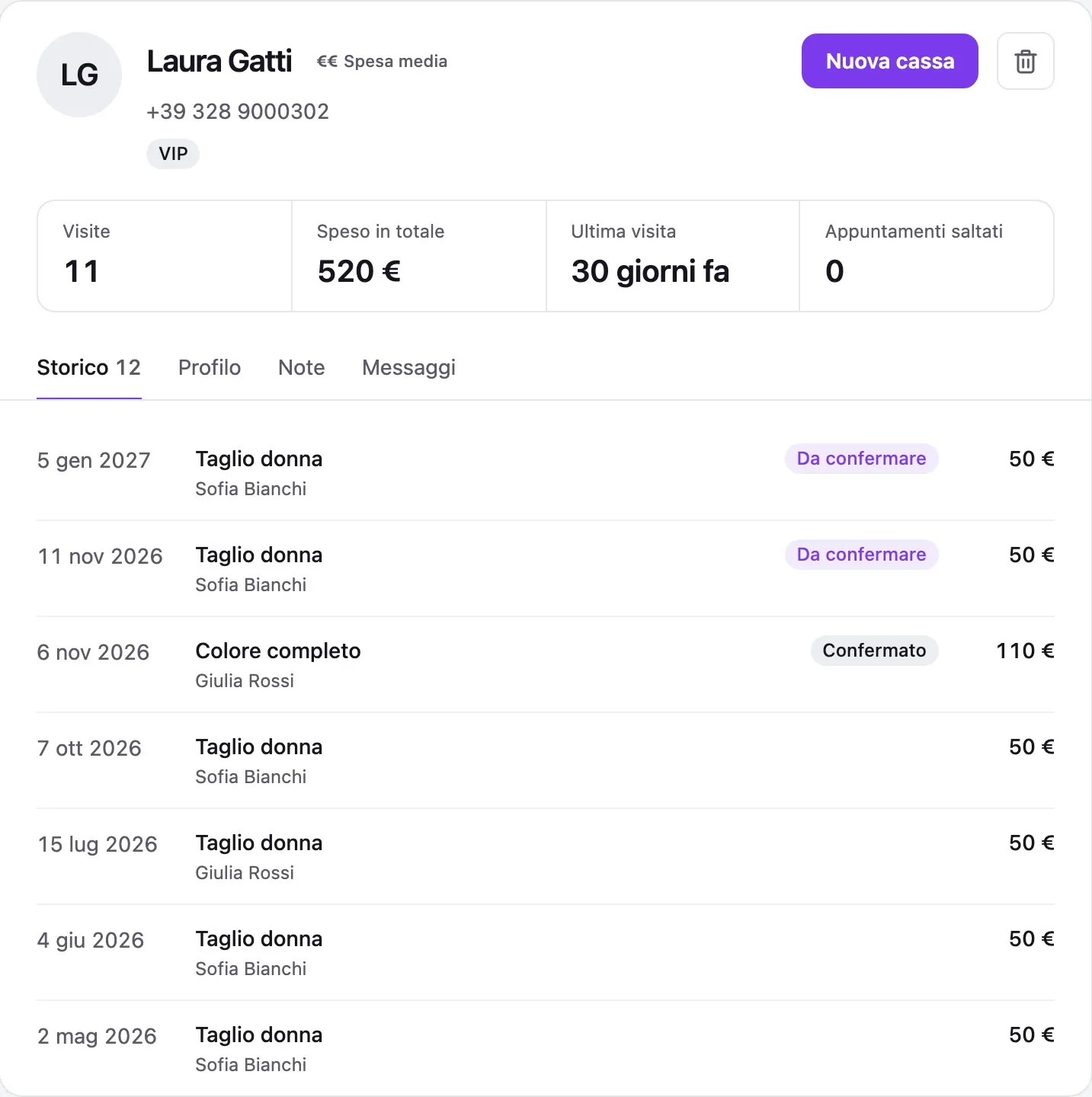
The client record in Kairo: visits, spend, last visit and the history of every service

Value at risk

“What do the clients I'm losing cost me?”

Not a list of names: a list of euros. For each client gone from her round, how much you stop taking in a year if she doesn't come back. They're ranked by weight, so you send the first message to the first row and don't have to decide where to start.

Why you can trust this number

Here's the difference that matters. Kairo doesn't use “60 days” for everyone: it uses each one's rhythm. Someone who comes every three weeks is late after thirty days, someone who comes every three months isn't at all — treating them the same means pestering one and losing the other. And the value is what she really spent, not what she might spend.

Value at riskannual revenue stalled · ranked by weight
Giulia R.€1,240
Marta C.€980
Elena V.€860
Sara P.€720
Chiara M.€610
Ask Kairo
Who should I call back first?Giulia. She came every three weeks and has been idle for six: she's worth €1,240 a year, the heaviest on the list. She hasn't gone for a serious reason, too much time has just passed. Shall I write the message?

Dormant curve

“How many clients do I have, idle for how long?”

How many clients you have at thirty, sixty, ninety days since their last visit. Look at the shape before the numbers: if it drops steeply the salon is healthy, if it stays high towards the right your base is emptying without anyone telling you.

Why you can trust this number

You'll notice there's no red line dividing the good from the bad. It isn't an oversight: lateness depends on each client, so a line at 60 days would tell a lie about half of them. Clients who came only once are counted here but not in the ranking, because they don't have a rhythm to break yet — and Kairo tells you how many there are instead of hiding them.

Days since last visit411 clients · 37 with a single visit
0–30
30–60
60–90
90–120
120+
Ask Kairo
How many am I losing?37 have been idle for more than four months, and honestly those are hard. But the 96 between one and two months are almost all recoverable, and they're still warm. That's where it pays to work now, not on the others.

Band migration

“Who moved up a band and who moved down, this quarter?”

Where your clients were three months ago (the rows) and where they are now (the columns). On the diagonal are those who stayed where they were; above, those who moved up; below, those who are slipping. It isn't a photo of what the salon is like: it's a photo of where it's heading.

Why you can trust this number

Seven bands, not a hundred and twenty-five boxes to decipher: if a table can't be read in ten seconds it's no use to anyone. And the thresholds are recalculated every time, so a year when everyone spends more doesn't make it look as if clients got better when only the price list changed.

From where they were → to where they arequarter · cells = number of clients
Gold
Loyal
Regular
Declining
Lost
Gold
18
6
2
3
1
Loyal
7
41
11
6
2
Regular
2
14
63
19
8
Declining
0
3
12
28
22
fewmany
Ask Kairo
Are things getting better or worse?Balanced, but with one good detail: you won back 12 clients who were slipping away, and they're worth more than the 6 you promoted at the top. The sore point is the 22 who left the round altogether — shall I prepare a list for those?

LTV by cohort

“Are the clients I gained in January worth more than March's?”

Each row is a month in which you gained new clients, each column how much time has passed since. Read it by rows and you see how a client gained in January grows over time; read it by columns and you see whether those joining today are worth more or less than those of six months ago.

Why you can trust this number

The dotted boxes are empty because that time hasn't passed yet, not because they're worth zero. It's the mistake that ruins this kind of chart everywhere: June looks bad only because it's had one month against January's six. Kairo would rather leave a box empty than give you a number that would worry you for nothing.

Cumulative value by cohort€ per client · · = not yet mature
M0
M1
M2
M3
M4
M5
Jan
48
96
141
178
212
240
Feb
44
89
130
166
198
·
Mar
51
104
152
191
·
·
Apr
46
92
138
·
·
·
May
53
108
·
·
·
·
Jun
49
·
·
·
·
·
0 €240 €
Ask Kairo
Are new clients worth what they used to be?Yes, even better. Clients who arrived in March had left you €191 after three months, those who arrived in January €178. March is your best cohort: if you remember what you did that month to get known, do it again.

Lengthening intervals

“Are my clients coming less often?”

How many days pass between one visit and the next, month by month. It's the bell that rings before all the others: before disappearing, a client comes less often. If this line rises, you're losing frequency even in months when takings look fine.

Why you can trust this number

Kairo uses the middle value and not the average, because two clients back after six months are enough to make the average say something false about everyone else. And to decide whether things are getting worse it compares the first months with the last in blocks, not two single months: that way a bad August doesn't become a diagnosis.

Days between one visit and the nextmonthly median · rising = coming less often
+7 days since January
JanMaySep
Ask Kairo
Why are takings the same but the salon feels emptier?Because it is. Your clients come back every 41 days against 34 in January: that's seven more days each. Takings hold because when they come they spend more, but you're seeing fewer people — and it's the signal that usually comes before a real drop.

Booking window

“How far ahead do they book, and for what?”

How many days ahead they book you, service by service. It's for two very concrete things: seeing how far ahead it makes sense to open the agenda, and knowing whether you can still fill Thursday's gap with a colour or by now only with a blow-dry.

Why you can trust this number

Here too the middle value and not the average: two ladies who book six months ahead would make a salon that really works with walk-ins look highly organised. And clients rung up at the till after they've already come in aren't counted as “zero-day bookings” — they're something else, and Kairo counts them separately.

Days aheadmedian by category
Highlights16 days
Colour12 days
Treatment9 days
Cut4 days
Blow-dry2 days
Ask Kairo
How far ahead should I open the agenda?Three weeks are enough: highlights are booked 16 days ahead, colour 12. Cut and blow-dry come two to four days ahead, so don't fill everything — always keep a few gaps free in the week for them, or you'll turn them away.

No analyst needed.

The answers you read above aren’t examples we wrote: this is how Kairo talks to you. Every chart has its “Ask” button, and from there on it’s a conversation — you ask it why, you ask it what you should do, you ask it to do it.

A real consultant you can afford once a year, and when they leave you’re left with a PDF. Kairo looks at the same numbers every day, and when you ask it “now what?” it prepares the action ready to approve.

Try it on your salon.

Live in 2 minutes. Free forever, no card needed.

Try it yourself