
Hair salon price list 2026: an example and how to work it out
Updated
An example price list to start from, the average prices recorded in Italian cities and the method to set yours starting from the salon's real costs, not from the salon across the street.
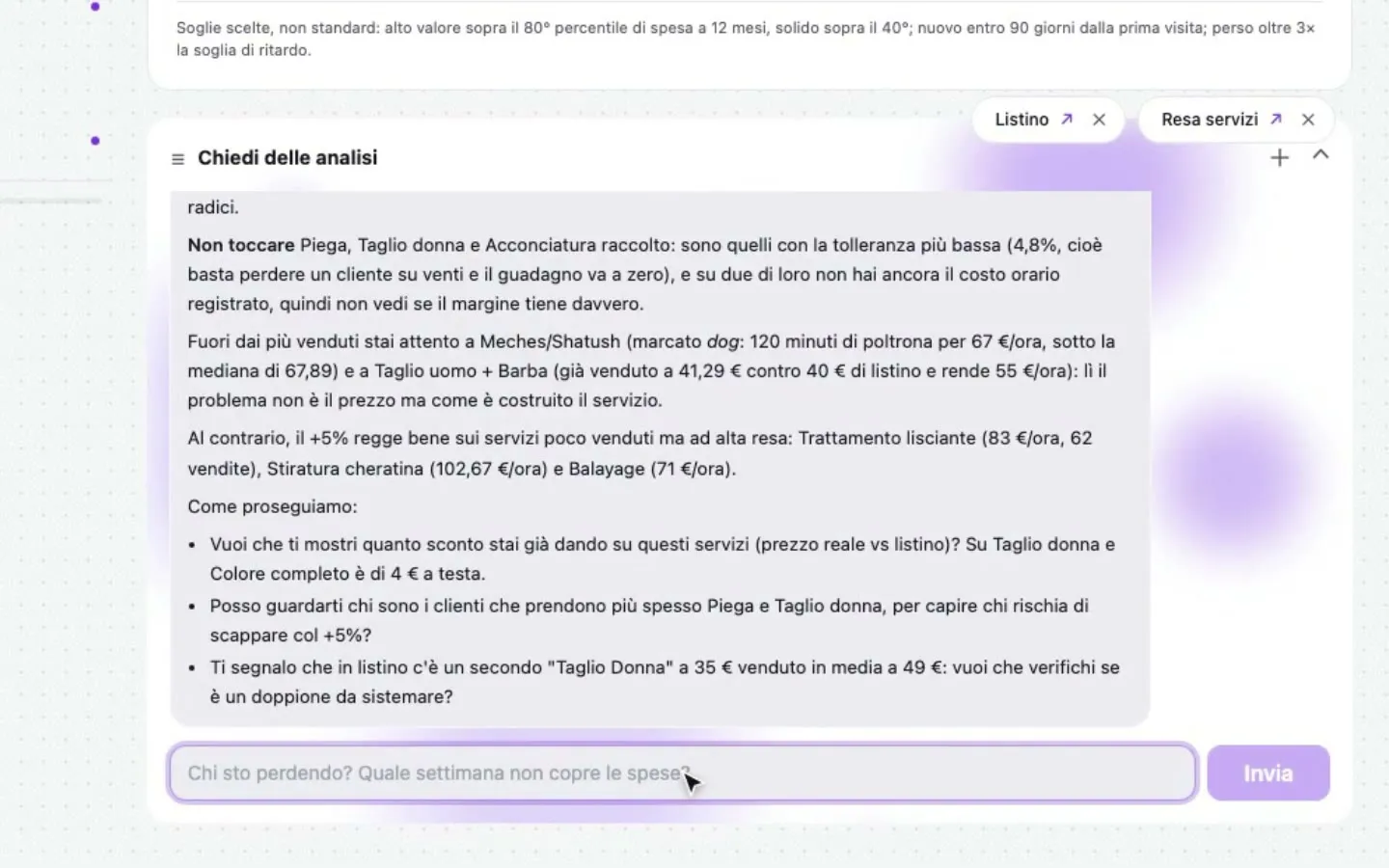
An example hair salon price list
A clear price list shows every service with its price and, where the work changes, bands by hair length. This is an example structure with indicative prices for a salon in a mid-sized Italian city, not official averages: adapt them to your costs with the method below.
- Blow-dry: short hair €20, long €28
- Women's cut with blow-dry: €40–48
- Root colour: €45; full colour: €60–75
- Highlights or balayage: from €90, depending on length
- Restructuring treatment: €20
- Men's cut: €20–25; cut and beard: €30
What a hairdresser costs in Italian cities
According to the Italian Ministry of Enterprise's price observatory (March 2026 data, analysed by SumUp), a women's cut and blow-dry costs on average €61.90 in Treviso and €61.80 in Reggio Emilia, the most expensive cities, and €29.20 in Naples and €30.20 in Palermo, the cheapest. Compared with a year earlier prices rose almost everywhere, up to +21.3% in Reggio Emilia; Palermo is the only city where they fell. They're averages: they tell you where the market sits, not how much you should charge.
The price list must be displayed: it's mandatory in Italy
Yes. In Italy hairdressers and beauticians must keep the price list of their services clearly and visibly displayed in the salon: consumer-protection rules and the municipal regulations that implement the sector laws require it (Law 174/2005 for hairdressers, Law 1/1990 for beauticians). A QR code can sit beside it, not replace it. And at the till you can't add a cost that wasn't stated and accepted beforehand.
What an hour of chair time costs you
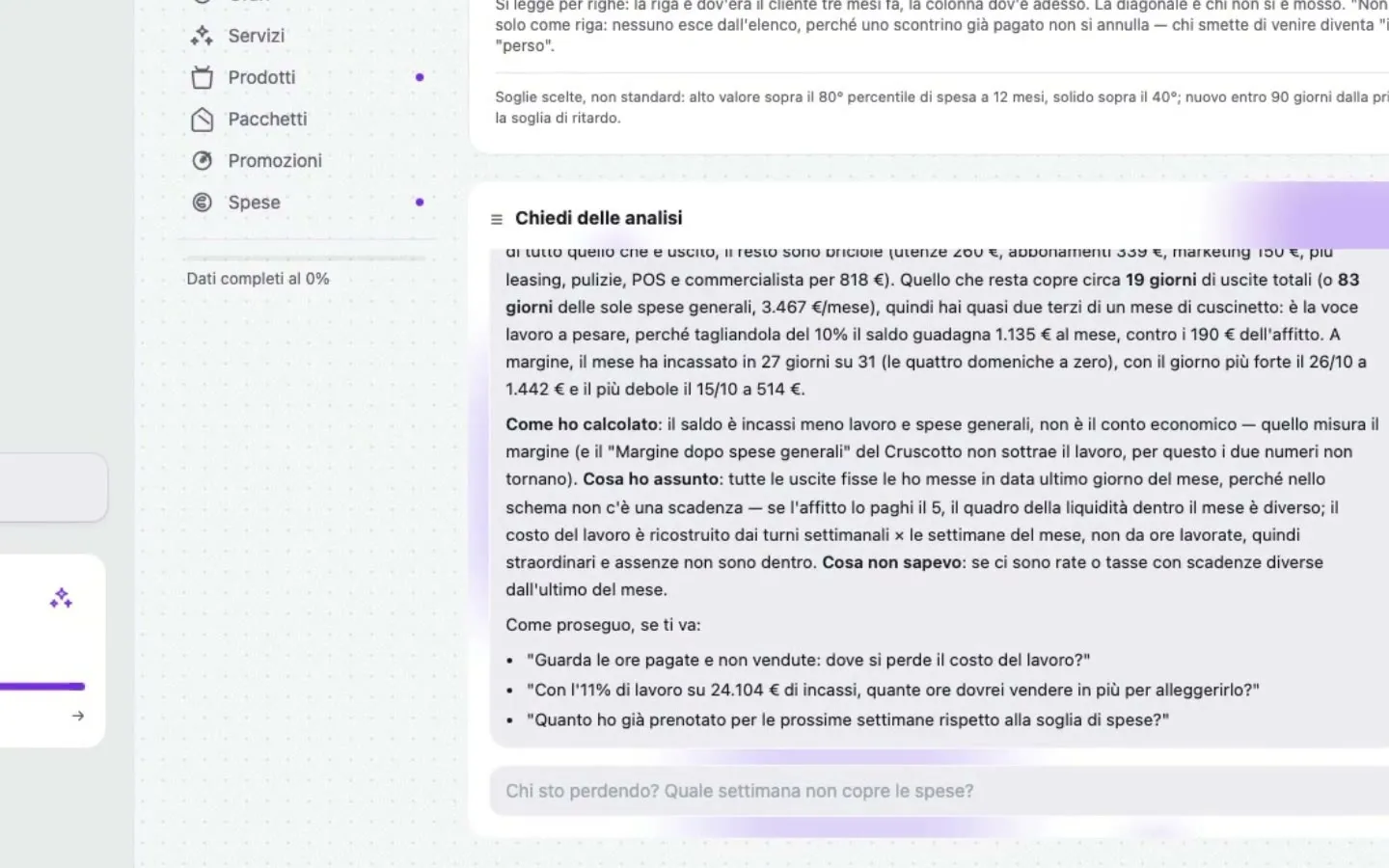
Add up a month's fixed costs: rent, wages and contributions, utilities, accountant, software, instalments. Then count the hours you can really sell: everyone's shift hours, minus breaks, cleaning and dead time between one client and the next. Divide the costs by the saleable hours and you have the cost of an hour of chair time. It's the most important number in the price list, and the one almost nobody knows.
- Monthly fixed costs (example): €12,800
- Shift hours: 3 people × 8 hours × 22 days = 528 hours
- Saleable hours, minus breaks and dead time (about 75%): 400 hours
- Cost of an hour of chair time: €12,800 ÷ 400 = €32, or about €0.53 a minute
The full cost of each service
For each service measure the minutes of real work, not those written in the agenda: while the colour processes, the chair can work for another client. Multiply the minutes by the cost per minute and add the product at its real dose, not per pack. The result is the price below which that service loses you money.
- Blow-dry (example): 40 minutes × €0.53 = €21.20 + €1.50 of product = €22.70 full cost
- Colour (example): 45 minutes of work × €0.53 = €23.85 + €9 of product = €32.85 full cost
From cost to price: the margin you want to keep
On top of the full cost goes the margin: your earnings, the reserve for slow months, investments. A simple way is to decide how much you want left in a month and divide it by the saleable hours: €4,000 over 400 hours is €10 more for every hour of work. If you're in Italy's ordinary VAT regime remember that the listed price includes 22%: take it off before doing the maths. Then compare with the neighbourhood: if you're well above, the price list must show why; if you're well below, you're giving work away.
The discounts the price list doesn't see
A fair price list empties out at the till: the discount for a friend, the colour rounded down, the free blow-dry. One by one they seem like nothing; added up over a month they can be worth as much as a price rise. Before raising prices, look at how much discount really goes out and who decides it.
How to announce a price rise
Announce it a few weeks ahead, in the salon and on WhatsApp, and say what stays the same. Adjust one service at a time instead of the whole list at once, starting with those that earn least per hour. Then watch your loyal clients over the next two months: if they keep coming back at their usual rhythm, the rise has held.
Where Kairo helps
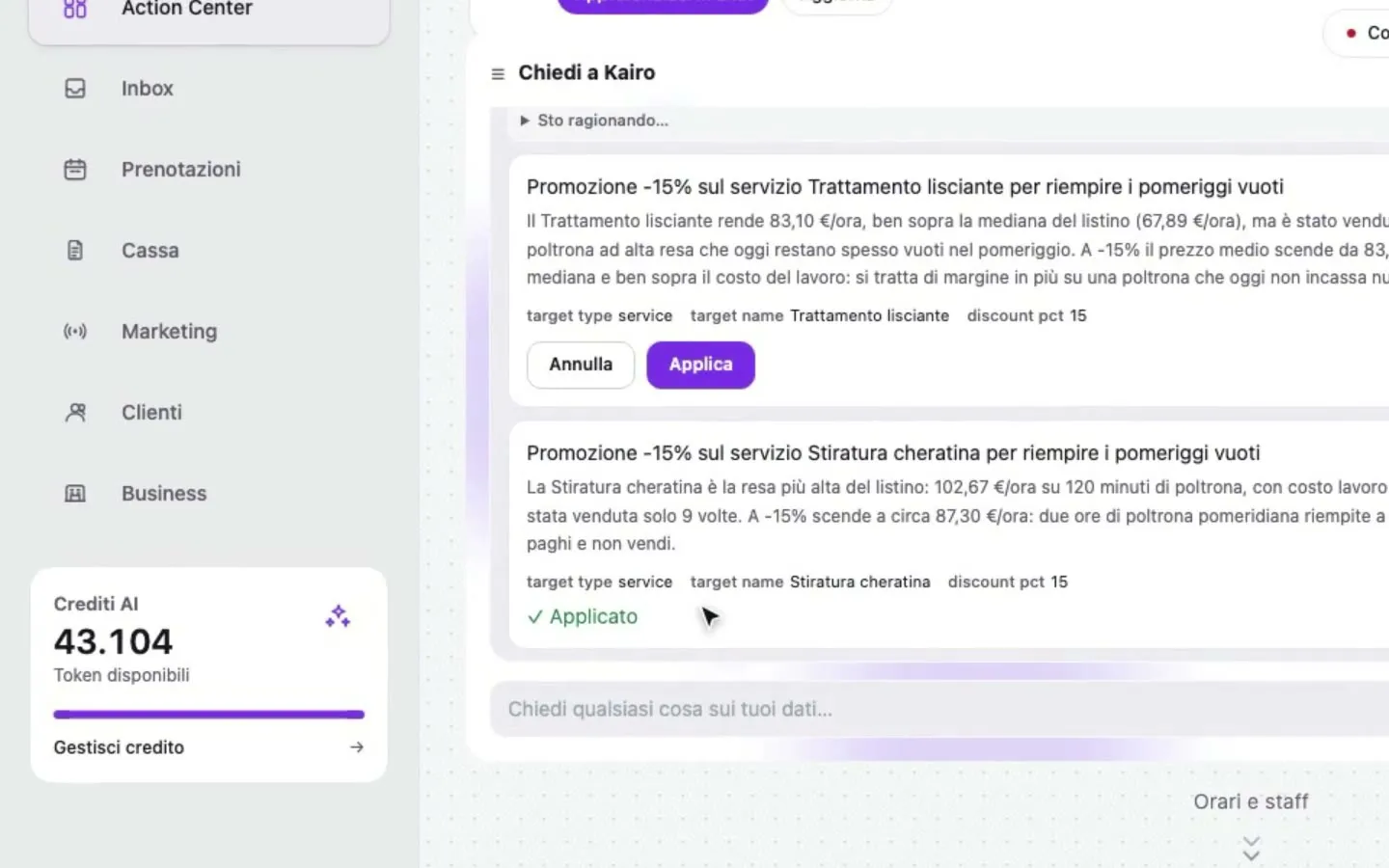
Kairo does these sums on the salon's real data: what an hour earns for each service and each person, how much discount leaves the till outside promotions, what happens if you raise a service by 5%. You ask it in plain words and it answers with your numbers. It doesn't change prices on its own: the decision stays yours.
Frequently asked questions
- Is a hair salon price list mandatory?
- In Italy, yes: it must be displayed in the salon clearly and visibly, with all the services offered. Consumer rules and municipal regulations require it; an online list or a QR code can sit beside it, not replace it.
- What does a women's cut and blow-dry cost on average in 2026?
- It depends a lot on the city: according to the Italian Ministry of Enterprise's price observatory (March 2026) it ranges from about €29 in Naples to about €62 in Treviso and Reggio Emilia.
- How often should the salon's price list be updated?
- At least once a year, and whenever a major cost changes: a new rent, an extra person, a rise in products. Before touching the prices, redo the cost of an hour of chair time.
- Fixed price or by hair length?
- If on long hair a service takes more minutes or more product, the full cost changes and so should the price. Write it clearly in the list, with bands: a vague “from” causes arguments at the till.
- Does Kairo work out the price list for me?
- Kairo shows you what each service earns per hour, how much discount leaves the till and what a tweak would change. It doesn't change prices on its own: you decide.