The hours you pay for and don't sell

A salon doesn't sell cuts and colours: it sells hours of work. Kairo looks at the same hours from two sides — what the hours you sell earn, what the hours you pay for and leave empty cost you — and arrives at the question that comes out of it: do I need another person, or do I need to fill what I already have?

The questions it answers

  • “When am I short-staffed and when do I have too many?”
  • “Which slots earn the most?”
  • “Do I need another person?”
  • “Why does Anna earn more than Sara?”

Lives in Business → Analysis · Till → Analysis

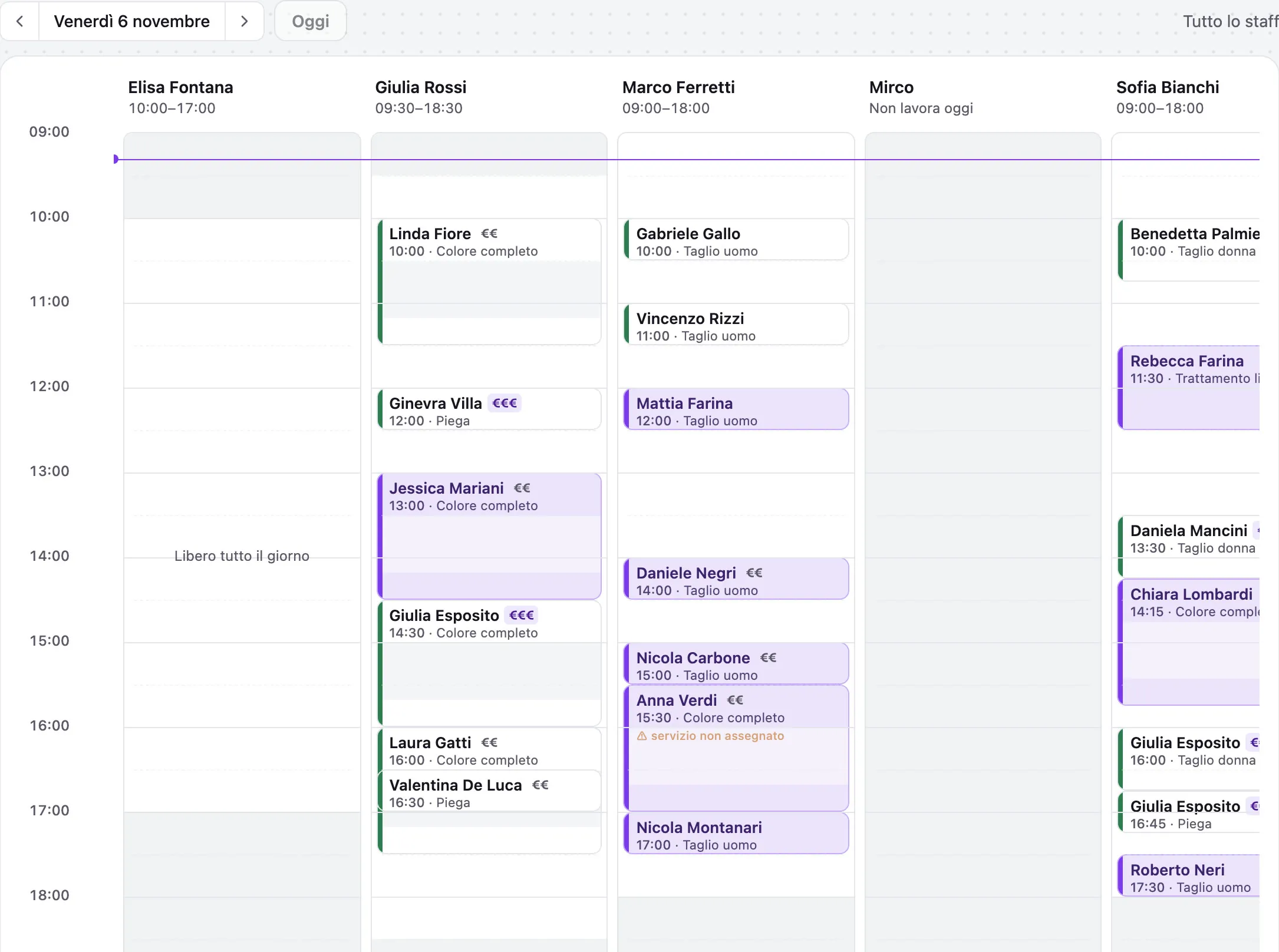
Kairo’s agenda with the day’s appointments, one column per person

Hours paid and not sold

“How many hours am I paying for without selling them?”

Day by day and hour by hour, what the time you pay for and leave empty costs you. This chart doesn't tell you where to run a promotion: it tells you where to move a shift. If Tuesday afternoon has been dark every week for two months, it isn't a client problem — it's a shift placed at the wrong time.

Why you can trust this number

The dotted boxes are the hours you were closed, and they stay empty instead of turning red. Colouring them as a loss would tell you that closing costs you, which is the opposite of the right advice. And since nobody clocks in, Kairo rebuilds the paid hours from the shifts, minus holidays and leave — it writes that every time it uses that number.

Hours paid and not sold€ · 8-week average · dotted = closed
09–11
11–13
13–15
15–17
17–19
Mon
·
·
·
·
·
Tue
48
22
61
34
18
Wed
39
14
55
12
9
Thu
41
18
58
21
11
Fri
26
8
44
6
4
Sat
11
3
29
5
12
almost all soldmany idle hours
Ask Kairo
Am I paying for empty hours?Tuesday between 13 and 15, every week for two months: that's €61 going out each time, about €240 a month. You're not short of clients in that slot, you have one person too many. Shall I propose how to move the shift?

Takings by slot

“Which hours earn me the most?”

The same grid, the other way round: how much comes in for every available hour, slot by slot. It's for deciding what to put where — which slot to keep free for a colour, which to fill with whatever comes, and on which day it really makes sense to drop a promotion.

Why you can trust this number

A month can have five Mondays and four Wednesdays, and if you don't account for it Monday looks stronger only because it came round once more. It happened on the test salon: it looked 20% better than Wednesday, and with the right sum it was the opposite. The promotion was about to land on the wrong day.

Takings per hour of work€/h · 8-week average · corrected for occurrences
09–11
11–13
13–15
15–17
17–19
Mon
·
·
·
·
·
Tue
38
52
21
47
58
Wed
44
61
24
56
66
Thu
41
57
22
51
60
Fri
49
68
28
64
72
Sat
66
84
39
78
71
weak slotstrong slot
Ask Kairo
When does it pay to be open?Friday and Saturday mornings are your golden hours: €84 an hour against €21 on Tuesday afternoon. If you had to extend a day I'd extend Friday evening, not Saturday — Saturday is already full, Friday still has room at that price.

The “+1 person” scenario

“Does it pay to hire?”

Three numbers in the same unit — hours a week — so you compare them by looking, without doing sums. How many hours you have empty now, how many more you'd need to sell for the new person to pay for themselves, and how many more you're actually selling each month. If the first bar is the highest, the answer isn't to hire.

Why you can trust this number

Below 70% occupancy Kairo tells you to fill what you have, and it says so even if the break-even sums worked. Hiring when you already have unsold hours means adding capacity on top of capacity nobody is buying. And it doesn't promise you any miraculous ramp-up: the clients you turned away because you were full aren't written anywhere, so a growth curve would be made up.

Hours a weekcurrent occupancy 63% · verdict: fill first
31 h
22 h
9 h
Empty today
To sell
Sold extra
Ask Kairo
Do I need another person?Not yet. You have 31 empty hours a week and you're selling 9 more a month: fill those first. You're at 63% — when you get above 70% we'll talk about it seriously, and at that point the sums change a lot.

Comparing team members

“Why does Anna earn more than Sara?”

In Till → Analysis every team member is a row you can click, and clicking it recalculates the whole page for that person: average bill, what they sell, which slots they work, which clients they're losing. It doesn't give a grade — it shows you the same things, one person at a time.

Why you can trust this number

The discount is attributed to whoever rang up that line, not to whoever closed the bill: without this distinction one person covering the till for the others is enough to turn the column into a slander. And only you see this table: no team member can open the comparison with colleagues, because a diagnosis is for you to teach, not for them to fight over.

Same views, one person at a timeSeptember · click a name and the whole page recalculates for that person
AnnaSaraLuca
Revenue7.420 €5.980 €4.310 €
Clients served10911792
Average bill68 €51 €47 €
Colour and highlights share54%29%33%
Average discount applied2,1%7,8%3,4%
Occupancy88%81%74%
Rebooking at checkout61%38%44%
le righe che spiegano il divario
Ask Kairo
Why does Anna earn more than Sara?Not because she's faster — Sara serves eight more clients than her. Anna does colour and highlights in 54% of cases against Sara's 29%, and discounts 2% against 7.8%. Those are two habits, not two talents: they can be taught. Shall I write what to tell her?

No analyst needed.

The answers you read above aren’t examples we wrote: this is how Kairo talks to you. Every chart has its “Ask” button, and from there on it’s a conversation — you ask it why, you ask it what you should do, you ask it to do it.

A real consultant you can afford once a year, and when they leave you’re left with a PDF. Kairo looks at the same numbers every day, and when you ask it “now what?” it prepares the action ready to approve.

Try it on your salon.

Live in 2 minutes. Free forever, no card needed.

Try it yourself